The whole child
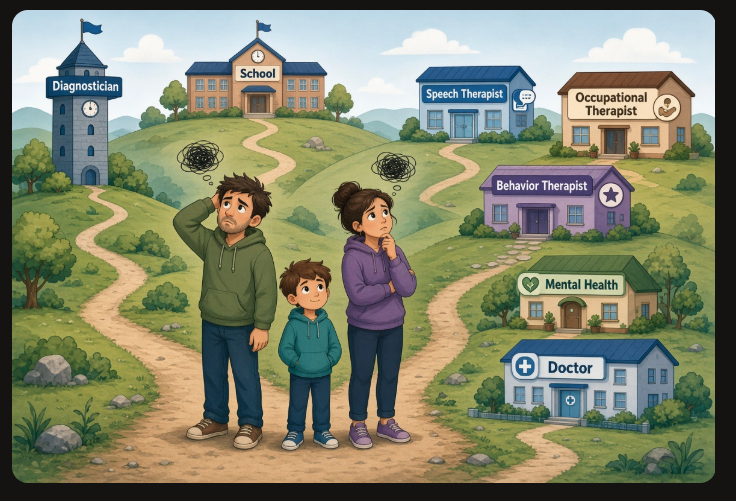
The waitlist is not a plan.
Providers who have never met aren’t a plan either.
Most families have therapists pulling in different directions. Drag the slider to see what changes when everyone sits at one table.
Book a Free Care Mapping call45 minutes with Ashleigh, BCBA. A conversation, not a form.
Cash pay. Insurance coverage coming soon (with your help). Serving families in Georgia, Florida, and North Carolina.
 Before: every directionAfter: one table
Slide to bring everyone to one table
The problem
You became the translator.
Your child's providers mean well, but they don't sit at the same table in the same room. Their plans pull in different directions, and you end up as the translator, coordinator, scheduler, and record keeper between all of them instead of just the parent. Roundtable Care takes that job off your shoulders from week one. You keep your seat at the table. You just don't have to run it anymore.
More hours are not the goal. One plan that everyone follows is.
How we compare
How Roundtable Care compares
Most families end up as the coordinator. Here is how the options stack up.
| Roundtable Care | Separate providers, you coordinate | Waiting on a waitlist | |
|---|---|---|---|
| Who is at the table | You, care navigator, BCBA, SLP, OT, and licensed mental health clinician | Each provider on their own | No one yet |
| Who coordinates | A care navigator | You do | You do |
| Your time spent coordinating care | Designed to sit with the team, not with you | About 1 in 3 families who coordinate care spend 1 or more hours a week; 8.4% spend 5 or more1 | Calls, forms, and follow-ups while you wait |
| Provider-to-provider meetings | Roundtables in weeks 1, 7, and 13 | Rarely built in | None |
| The plan | One plan, one set of outcomes. You leave week 14 with a treatment plan | A separate plan from each provider | No plan yet |
| Getting started | A Free Care Mapping call. A conversation, not a form | Separate intakes and evaluations with each provider | 61% of U.S. autism centers surveyed had evaluation waits over 4 months; 15% over a year2 |
| Impact on work and income | Designed to take the coordinator job off your plate | Mothers of autistic children earned 56% less a year than mothers of children with no health limitation3 | Same pressures, plus the wait |
Roundtable Care entries describe how the service is set up. Individual results vary. Other columns are national research findings, not a measure of any one provider.
- 2022 National Survey of Children's Health, Indicator 6.20b. nschdata.org
- Wait Times and Processes for Autism Diagnostic Evaluations: A First Report Survey of Autism Centers in the U.S. cms.gov
- Cidav Z, Marcus SC, Mandell DS. Pediatrics. 2012;129(4):617-623. PMC3356150
The table
Pull up a chair for everyone who works with your child.
Tap each person to see where they sit today and how they work with the table. Everyone at the table works toward the same short list of goals for your child, and we check them at home, not only in session notes.
The 14 weeks
Fourteen weeks to a plan everyone follows.
Week one puts everyone at the same table. The weeks after that keep everyone on the same plan. Step through the season.
The 14-week season
What's included in the 14-week season
Every family in the cohort gets the whole table, not a menu of add-ons.
Your team at one table
- Your family at the center
- Care navigator
- BCBA
- Speech-language pathologist
- Occupational therapist
- Licensed mental health clinician, with support for parents too
Roundtables and your plan
- Roundtable in week 1: we sit together from the start and write a joint plan
- Roundtable in week 7: what is moving, what to drop
- Roundtable in week 13: confirm what holds
- One list of shared goals, checked at home, not only in session notes
- One treatment plan you get to take with you
Between the tables
- The team runs the plan you wrote together
- Coordination stays on our side
- You gain some peace while we do the heavy lifting for you
- 1:1 parent meetings
- Group meetings and trainings too. You're not alone!
Your care navigator
- Coordinates every meeting and roundtable, and handles scheduling and follow-up for you
- Supports collaboration with your child's current providers, school, and doctor
- Helps with paperwork and applications, like scholarships, waivers, and other supports your child needs*
- Brings your diagnostician's report into week 1
- One point of contact when something comes up between sessions
What the season is designed to give you
- One team, working from one plan
- Less coordinating for you. You are not the referee
- A plan built to hold after week 14, not to keep you forever
This describes how the season is set up. Every child is different, and individual results vary. *Help with applications does not guarantee approval.
Free Care Mapping call
What you get on your Free Care Mapping call
Forty-five minutes with Ashleigh Dominguez, BCBA, founder of Roundtable Care. It is a planning conversation, so you can see clearly what your child has now and what to do next.
Your full picture
We map the providers and services your child has now.
Where the gaps are
We look at what is missing and where plans pull apart.
What is wearing you down
We name what is actually breaking at home right now.
What matters most
We start from your family's priorities, not a package.
An honest fit check
Whether the 14-week table is the right next step. If we don't offer what you need, we will tell you.
Clear next steps
You leave with a clearer picture of next steps, whether or not we work together.
This is not a therapy session or an intake. We will not diagnose or give treatment advice on the call. Please do not put your child's full name or medical details in the booking form.
From Ashleigh
Why Roundtable Care exists
I'm a BCBA, but I'm not your BCBA. I built the table I wished families had.
Questions
What families ask first
Do we have to leave our current therapists?
For Cohort 1, the Week 1 chairs are family, BCBA, speech-language pathologist, occupational therapist, licensed mental health clinician, and care navigator on our internal team. Existing outside providers do not sit Cohort 1. We talk through what that means for your family on the Care Mapping call.
What does "whole child" mean here?
Behavior, communication, sensory and motor needs, mental health, and home life are worked on as one plan with one set of outcomes, not as separate silos that each send you home with homework.
Which states do you serve?
Georgia, Florida, and North Carolina.
What happens after week 14?
You leave with one treatment plan you can actually keep, built to hold when we are not in the room, not to keep you forever.
What is the Care Mapping call?
Forty-five minutes with us. We map what is breaking at home and whether the 14-week table is the right next step. There is no form to fill out first.
More answers in the full FAQ.
Cohort 1
Forty families. Georgia, Florida, and North Carolina.
If you are done waiting, sit down with us. The Care Mapping call is forty-five minutes. A conversation, not a form. We map what is actually breaking at home, and whether this 14-week table is the right next thing.
- Now accepting families in Florida, Georgia and North Carolina
- Each cohort is capped at 40 families
- Last call: December 18, 2026